Showing posts with label Climbing Plant Support. Show all posts

Monday, 5 October 2009

Spiraclimb at the National Trust

Last month was an exciting one for Spiraclimb as we made our first delivery since becoming approved suppliers for the National Trust. This means that hopefully in 2010, Spiraclimb will be much more widely available through their national chain of plant shops.

Appropriately enough it was a local garden, Trelissick, that placed the first National Trust order and the regional paper, the Western Morning News, sent a reporter along to record the event. The plant center manager, John Gallagher, very helpfully planted up a tall planter using the sample we had sent him so that the photographer had a plant on a Spiraclimb to photograph!


In addition, as you can see, he took some pictures of the Spiraclimb in its packaging.


The delivery represents a new and exciting phase for the company. As a small Cornish company with a single product, to be able to supply a national chain (and in doing so raise money for the National Trust's valuable work) is an excellent opportunity and we hope that in doing so more gardeners will discover and enjoy growing with Spiraclimb.


Wednesday, 12 August 2009

Spiraclimb on the move

Sad news from the Spiraclimb Garden! Due to a house move the garden as we have come to know it here will cease to exist by the end of the month. The small plot I have been using is being turned over to a large brood of chickens - who I am sure will enjoy the slugs more then I have!

With all the organisation behind the move and the spell of bad weather the slugs have managed to get the upper hand and destroyed almost everything that was planted on and off the Spiraclimb so there is less to move then I would like.

However, not to be put off, this blog, and my gardening exploits, will continue in a slightly different form. The new focus due to constraints of the property will be pot and tub-grown plants which are ideal for the Spiraclimb. Patio tubs and containers offer an ideal location for the Spiraclimb support as they are compact and by using Spiraclimb you can grow climbers in pots where you could not before.

So keep your eyes peeled as the Spiraclimb Garden moves into a new and exciting phase and style - pics to follow soon.

Wednesday, 15 July 2009

How tall can you go with Spiraclimb?

This is a common question we receive by email and telephone. The canes pictured in my garden are just under 1m. Scientific experiments in controlled conditions (my colleague Dave, me, a Spiraclimb and a tape measure to be precise) have shown the Spiraclimb will go to just under 1.5m tall provided you have a fairly stout cane to mount it on.

Its worth remembering, though, that Spiraclimb is made from galvanised steel, as opposed to elastic, and so the height of the cane doesn't really change much beyond the visual style. A tall cane will draw the spirals in closer to the cane for a taller, narrower spiral whilst a shorter cane, as I opted for, produces wider more shallow spirals.

A consideration for me in selecting the height of the cane was the effect that the hoped-for crop of beans would have and I was seeking to avoid creating more weight then my cane could comfortably support.

With any cane height you can still support much the same length of lateral plant growth and, of course, when the plant reaches the top it can be trained back down again!

Click on the link for additional Spiraclimb growing tips.

Monday, 22 June 2009

Things taking shape! (A spiral shape)


Well, the weather stayed reasonably fine and so the beans and the last of the bedding plants grown from seed went in the ground. The greenhouse now only has a tray of Busy Lizzie's in it, which need a bit longer before going into hanging baskets and tubs.

The idea with the Spiraclimb displays was to create height at the back of the flower bed, integrating runner beans to the garden without any trellis support. This is essentially what Spiraclimb was invented for. I opted for canes at the shorter end of the height range but assuming the plants make it, I will demonstrate that they will grow healthily and should provide a very decent crop all being well.

As a growing tip, I must stress how important it is not to twist the growth onto the Spiraclimb support too tightly. It is easy to snap off the shoots if you do (and I did on a couple - but the plant has already started putting out new ones). The Spirals make an attractive feature by themselves but when filled with foliage and red flowers I am confident that the garden will look great with this combination of height and bedding.

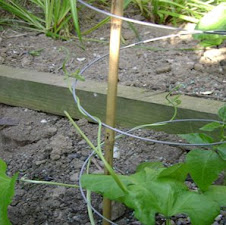
The Spiraclimb have been set out in a fairly central position in the bed and are entirely self-supported on the canes. The long hook at the base of the Spiraclimb allows for the cane to be pushed into the soil to a sufficient depth to be sturdy and obviously as the plants take to the support the structure becomes stronger still.

For all its simplicity of appearance, the Spiraclimb is a pretty carefully thought out design. The hooks anchor the support each end of the cane - similar immitations require a hook to be jammed into the soil to anchor the spiral which is nowhere near as simple or sturdy. The base of the Spiraclimb has an "arch" which tucks around the cane and heps provide tension and spaces the spiral correctly up the length of the cane. Finally, the top hook is on a short arm which correctly spaces the top loop of the Spiral out from the cane.

Full details and assembly instructions can be seen in the "How to use Spiraclimb" section of the main website.

Thursday, 4 June 2009

Beans coming along nicely!

After the false-start the second crop of Spiraclimb beans are showing signs of life! Runner beans are well suited to being grown on Spiraclimb and the spiral shape allows for easy cropping when the beans form. I find that between two and three bean plants can be grown on a single Spiraclimb to provide a dense spire of foliage.

The plan for the Spiraclimb garden is to integrate the runner bean plants into the main flowerbed. A row of four garden canes will provide support for three plants each, providing an attractive backdrop to the bedding plants at the front.

A similar effect could be created using tripod structures but these would take up quite a bit more room. As it is, using Spiraclimb allows me to plant out a very respectable number of plants in a fairly compact space.

You can get a range of tips for growing plants with Spiraclimb on the Spiraclimb website. The site also has a detailed how to use your Spiraclimb section.

Monday, 1 June 2009

A busy weekend!

Phase 2 of the Spiraclimb Garden occurred this weekend thanks to some great weather and an unaccountable surge of energy on my part! Maybe it was the sugar in the donuts I ate or something but in any case, about 3/4 of the plot has now been cleared.

The Spiraclimb garden used, as far as I can tell, to be a vegetable plot tucked away in a forgotten corner of the main garden. It has long since fallen into disuse and had completely overgrown with grasses, brambles, ferns and saplings from the nearby hazel tree. It was also completely covered in bluebells.

Unfortunately, the species of bluebell is Spanish, which is an attractive but aggressive species that is steadily driving out the native variety. I have heavily culled the bulb stock, therefore, transferring a few to pots where they can do no harm. Given the numbers involved, though, I very much doubt that the plot will be entirely free of bluebells!

My initial task has been to clear the plot of overgrowth and aggressive weeds and also to level off the plot for fresh planting. In the past it appears a large tree or shrub was dug out and so the plot has a crater in the middle which, once cleared of overgrowth, will need to be leveled.

Progress so far:
  • uncover the path to the garden,
  • clear overgrowth from the Cornish stone wall along one side,
  • discover/define the edges of the plot (turned out to be a raised bed)
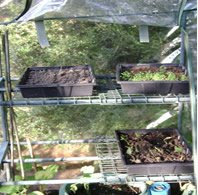
  • Set up two mini greenhouses for seeds/young plants
  • begin clearing the main bed of overgrowth
  • save & transplant some plants from the bed into pots

The idea of the Spiraclimb Garden, aside from giving me a garden space I can enjoy, will be to experiment with using Spiraclimb in the actual beds to bring height and allow for the support of climbers within the garden.

My initial plan is to plant out a crop of Spiraclimb runner beans, if the slugs can be kept at bay. After the first seeds failed to germinate (my mistake - used old seeds!) I replanted and the new crop are just about sprouting now.

For the record, although I am not 100% organic in my approach I have sourced slug pellets that meet organic standards and are not harmful to pets, birds or hedgehogs. They also quickly degrade into the soil. You can get additional tips on growing runner beans with Spiraclimb on the Spiraclimb website.

Tuesday, 12 May 2009

Introducing Spiraclimb

Welcome to the Spiraclimb Garden blog!

I guess the first question that deserves an answer is why/what is Spiraclimb?

Spiraclimb is a uk invention produced by a Cornish company. The concept is to provide a self-supporting topiary style spiral for climbing plants. The Spiraclimb clips over each end of a standard garden cane and supports up to 3m of lateral plant growth.

The advantages of Spiraclimb are that they allow gardeners to grow climbers in locations that are not ideal for bulky trellis. Spiraclimb allows even quite large climbers to be grown in patio pots and tubs, for example, by supporting and containing their growth. If using a sturdy, heavy pot (as opposed to a plastic version) Spiraclimb can also be quite successful in exposed or windy locations as plants are fully supported along their length and the height is limited to that of the cane.

The great benefit of Spiraclimb is that it opens up new locations for attractive climbing plants - giving gardeners more scope to grow whatever the restraints of their garden/patio and location.

Visit Spiraclimb at www.spiraclimb.co.uk
Order Spiraclimb today!